A car is not one machine. It is a set of systems that have to agree with each other: something creates power, something sends that power to the wheels, something slows the car down, and a body holds the people and the parts in place. This guide explains the basic car components and their functions in plain language, so you can talk to a technician, a parts buyer, or a shop with the right words.
It is a reading guide, not a repair manual. Procedures, torque specs, and wiring diagrams belong in the service information for your exact vehicle.
Main car components and their functions
Use this diagram as a map. Each label is a system, not a single bolt. When a car “doesn’t feel right,” the cause is usually inside one of these groups — or at the point where two groups meet, such as an engine mount, a wheel bearing, or a wiring connector.
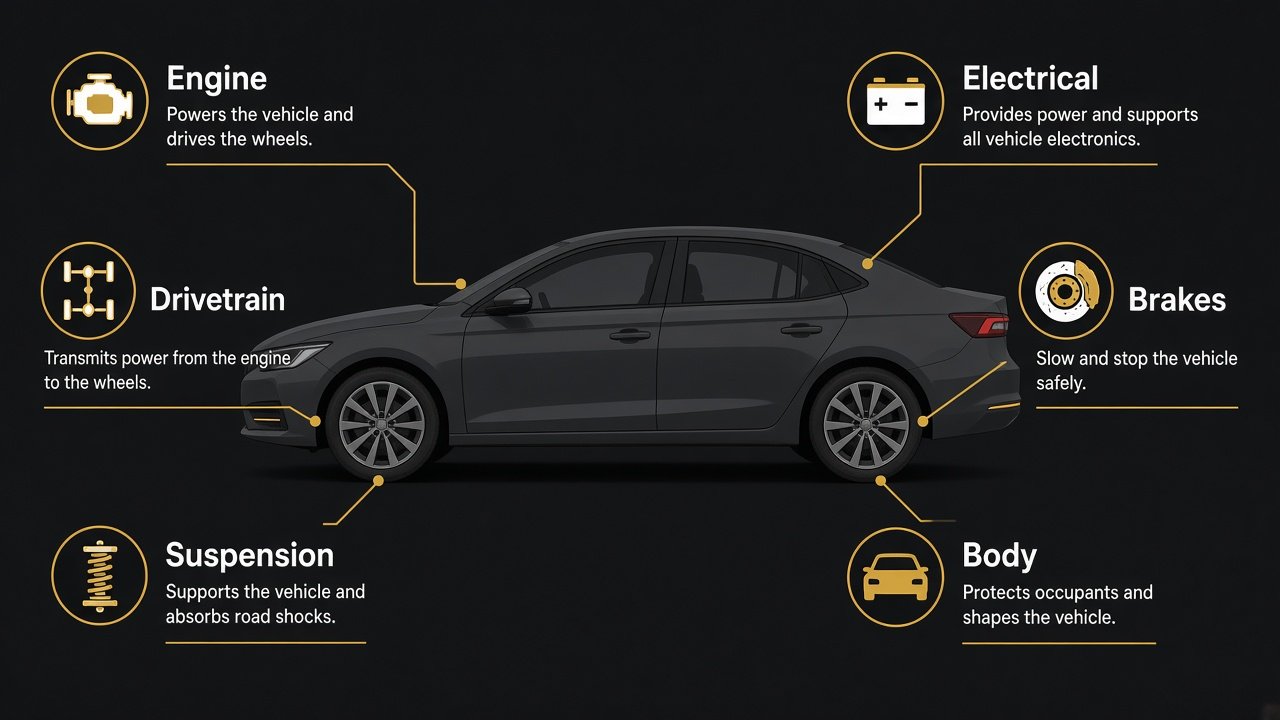
- Engine or electric drive — creates the force that moves the car.
- Fuel, intake, and exhaust — feed a combustion engine and carry gases away. Electric cars replace most of this with a battery and inverter.
- Cooling — keeps temperatures in a range the engine, motor, and battery can survive.
- Electrical — starts the car, charges the battery, and powers lights, sensors, and screens.
- Drivetrain — transmission, driveshafts, and differentials send power to the wheels.
- Chassis — suspension, steering, and brakes control grip, direction, and stopping.
- Body and exterior — structure, doors, bumpers, glass, and aero parts.
- Interior and safety — seats, restraints, airbags, and the controls you touch every day.
Engine function: how a car creates power
Most cars on the road still use an internal combustion engine. Air and fuel enter a cylinder, the mixture is ignited, and the pressure pushes a piston. That up-and-down motion becomes rotation at the crankshaft. Electric cars skip combustion: a battery feeds a motor that turns a shaft directly.
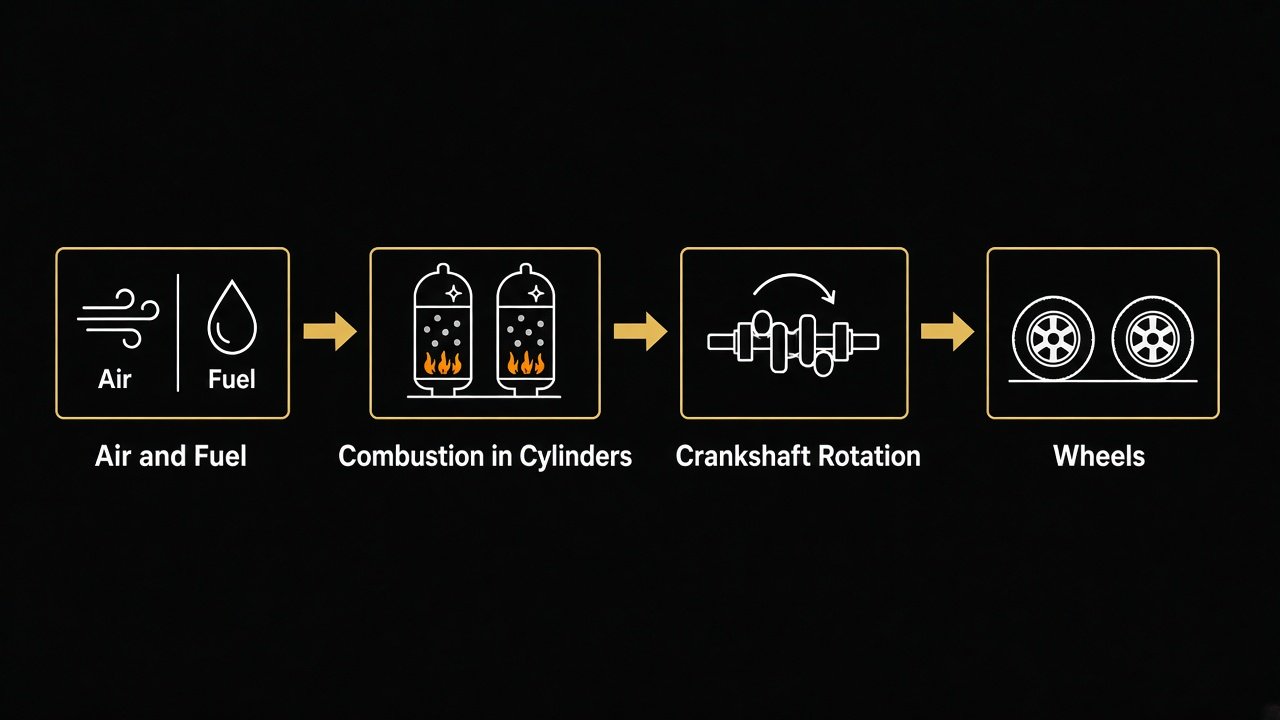
Gasoline engine parts
- Cylinders — chambers where combustion happens. More cylinders usually means smoother power, not automatically more reliability.
- Pistons — move up and down inside the cylinders and pass force to the connecting rods.
- Crankshaft — turns that linear motion into rotation.
- Camshaft and valves — open and close intake and exhaust ports so the engine breathes on time.
- Spark plugs — ignite the mixture in a gasoline engine. Diesels ignite by compression heat instead.
- Oil system — a pump circulates oil so metal parts do not weld themselves together from friction.
Electric car drive components
- High-voltage battery — stores the energy that used to come from a fuel tank.
- Electric motor — converts electricity into torque, often with strong pull from a stop.
- Inverter — switches battery DC power into the form the motor needs.
A hybrid uses both ideas: a smaller combustion engine plus one or more motors, so the car can cruise on electricity, assist the engine, or recharge while slowing down.
Fuel, exhaust, and cooling functions
These systems do not “make” horsepower by themselves, but the engine stops or overheats quickly if they fail.
| Component | Function | What drivers notice when it fails |
|---|---|---|
| Fuel pump and injectors | Move fuel from the tank and meter it into the engine. | Hard starting, hesitation, or a car that cranks but will not run. |
| Air filter and intake | Let the engine breathe while keeping grit out. | Flat power, higher fuel use, or unusual intake noise. |
| Exhaust and catalytic converter | Carry burned gases out and reduce harmful emissions. | Rotten-egg smell, a loud leak, or a check-engine light. |
| Radiator, pump, and thermostat | Move coolant so the engine stays in its temperature window. | Temperature gauge climbing, sweet coolant smell, or steam. |
Electrical system parts and functions
Turn the key — or press the start button — and the electrical system is what wakes everything else up.
- 12-volt battery — supplies the burst of power to start a combustion engine and keeps memory alive for clocks, locks, and control units when the car is off. Electric cars still use a 12-volt battery for these low-voltage jobs, separate from the big drive battery.
- Alternator — while a combustion engine runs, it generates electricity and recharges the 12-volt battery. If it fails, the car may run until the battery is empty, then stall.
- Starter motor — cranks the engine until combustion takes over. A single click and no crank is a classic starter or battery symptom — but only a test can tell which one.
- Fuses and relays — fuses sacrifice themselves to protect wiring. Relays let a small switch command a high-current device such as a fan or fuel pump.
- Sensors and control units — measure speed, temperature, pedal position, and wheel slip, then tell the engine, brakes, and lights what to do.
Drivetrain parts and functions
The engine or motor spins. The tires need that spin at the right speed and the right axle. That is the drivetrain’s job.
- Transmission — automatic, dual-clutch, manual, or a single-speed reduction gear on many EVs. It matches engine speed to road speed.
- Clutch or torque converter — lets a combustion engine stay running while the car is stopped, then locks power to the gearbox as you pull away.
- Driveshafts and axles — carry rotation to the front wheels, rear wheels, or both.
- Differential — lets the outside wheel turn faster than the inside wheel in a corner. Without it, tires would scrub every time you turned.
- Transfer case — on many all-wheel-drive vehicles, splits power between front and rear axles.
Layout names you will see on spec sheets: FWD (front-wheel drive), RWD (rear-wheel drive), and AWD (all-wheel drive). The layout changes which axles, differentials, and cooling parts a car needs. It does not change the job: deliver torque without breaking traction the driver did not ask for.
Brake, steering, and suspension functions
These three decide whether the car goes where you point it and stops when you ask.
Brakes
- Pedal and booster — multiply your foot force so you are not trying to stop a car with leg strength alone.
- Master cylinder and fluid — turn pedal motion into hydraulic pressure. Fluid that has absorbed water or leaked will make the pedal feel soft.
- Calipers, pads, and rotors — clamp the rotor and turn motion into heat. That heat has to go into the air; faded brakes are often overheated brakes.
- ABS and stability control — pulse brake pressure so a wheel can keep steering while it slows. They use wheel-speed sensors, not guesswork.
Steering
- Steering wheel and column — your input, plus the shaft that carries it forward. Modern columns collapse in a crash so the wheel does not spear the driver.
- Rack and pinion — the common passenger-car gear that turns rotation into side-to-side motion at the wheels.
- Power assist — hydraulic or electric help so parking does not require a strong arm. Electric assist is also what lane-keeping systems nudge.
- Tie rods — the last links out to the steering knuckles. Wear here shows up as wandering or uneven tire wear.
Suspension
- Springs — hold the car up and absorb big bumps.
- Shock absorbers or struts — control how fast the spring rebounds. Worn shocks let the car bounce after a dip.
- Control arms, bushings, and ball joints — locate the wheel so it stays pointed correctly while it moves up and down.
- Anti-roll bar — links left and right so the body leans less in a corner.
Body and exterior parts
The body is the structure you sit in and the panels you see. On a unibody car, many of those panels also add stiffness. On a body-on-frame truck, a separate frame carries the load and the cab bolts to it.
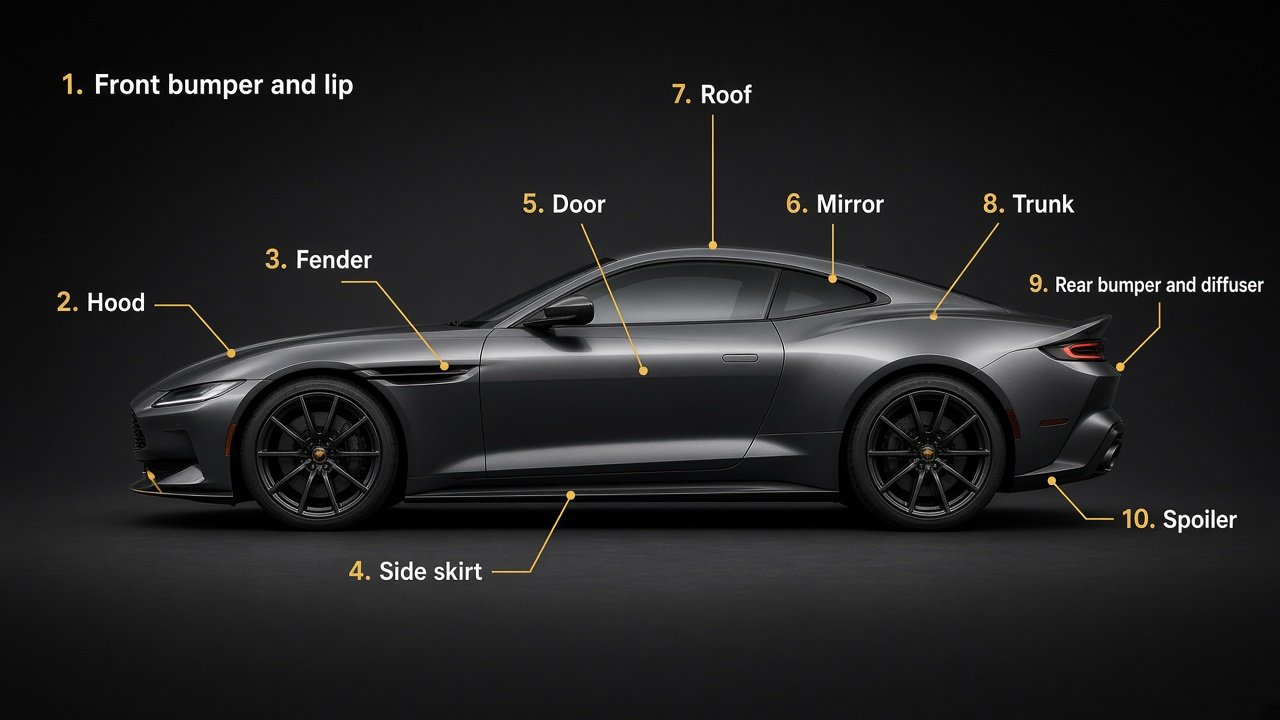
- Frame or unibody — the skeleton. Crash structures in the front and rear are designed to crush in a controlled way.
- Bumpers and bumper covers — absorb low-speed hits and carry sensors, cameras, and lights.
- Hood, fenders, doors, roof, and trunk — close the cabin, manage airflow, and give access to the engine or cargo area.
- Glass and mirrors — visibility. A windshield is also a structural piece on most modern cars.
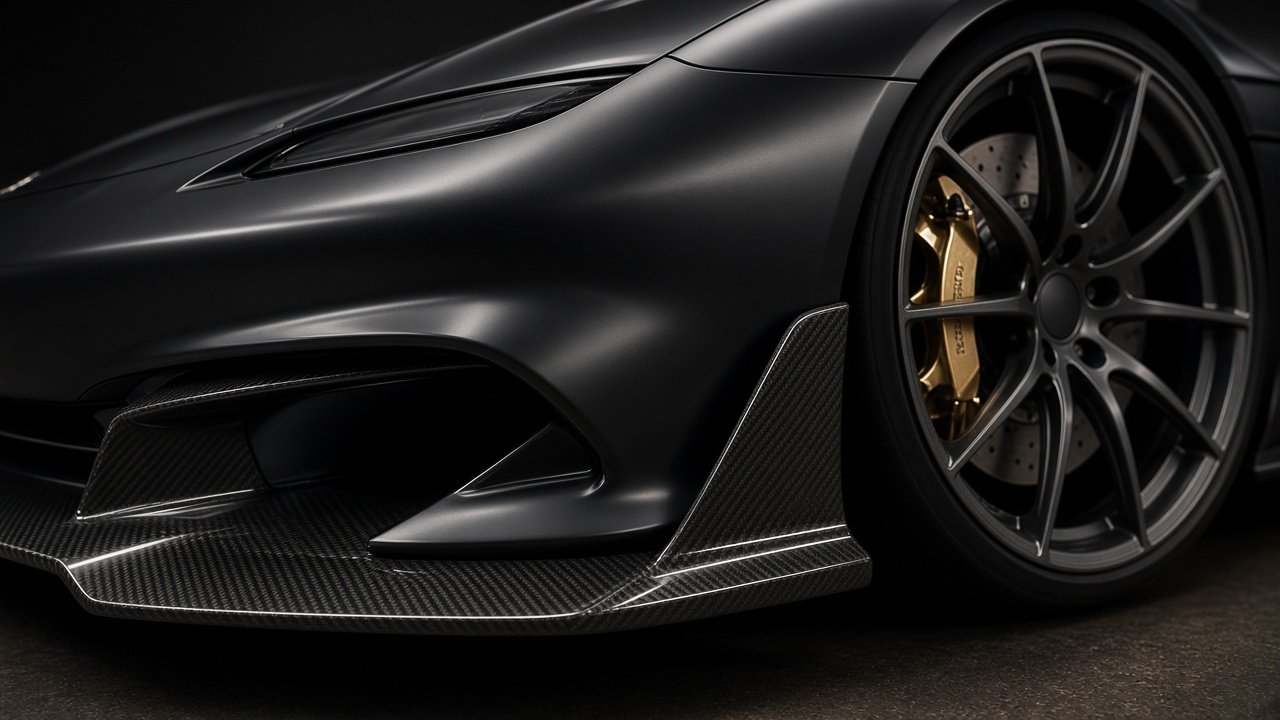
- Aero parts — lips, splitters, side skirts, diffusers, and spoilers guide air. A well-matched set can reduce lift and complete a styling package. A random mix of panels often fits poorly and does little for airflow.
- Lights — headlights, tail lamps, and signals. They are safety equipment first and a styling choice second.
Shops that install exterior upgrades usually start with the bumper, lip, and diffuser because those pieces change the look without rebuilding the suspension. If you are sourcing those parts for a specific model, the body kit categories on this site are organized by part type, and each brand page is written around vehicle compatibility — not as official factory equipment.
Interior and safety components
- Seats and seatbelts — hold people in the survival space the body shell creates.
- Airbags — inflate in a crash, then deflate. They work with the belt, not instead of it.
- Dashboard and pedals — the human interface: speed, warnings, steering, throttle, and brake.
- HVAC — heater, air conditioning, and blower. On electric cars the cabin heater is a real range item because there is less waste engine heat to reuse.
- Infotainment — screens and audio. Useful, but not required for the car to move.
How car components work together
- You request speed with the pedal. A sensor tells the engine computer or the motor inverter.
- Power reaches the transmission, then the differential, then the tires.
- The tires are the only parts that touch the road. Suspension keeps them planted. Steering points them.
- Brakes turn that motion back into heat when you need to stop.
- The body keeps occupants inside a protected space and gives the other systems a place to bolt on.
That is why a noise, a warning light, or a vague steering feel is worth describing precisely: which system, which side of the car, and whether it happens while braking, turning, or accelerating. Those three clues usually point a technician at the right group of components before any parts are ordered.
FAQ
What are the main parts of a car?
The groups that matter most are the power source (engine or electric motor), fuel or battery system, cooling, electrical system, drivetrain, suspension, steering, brakes, and the body that surrounds them.
What is the difference between the engine and the transmission?
The engine or motor creates torque. The transmission changes how that torque is geared to the wheels so the car can pull away, cruise, and — on multi-speed gearboxes — stay in an efficient rev range.
Do electric cars have the same components?
They still have a body, suspension, steering, brakes, tires, a 12-volt electrical system, and a drivetrain. They replace the fuel tank, exhaust, and most of the combustion engine with a high-voltage battery, inverter, and one or more motors. They usually have simpler transmissions.
Which exterior parts are usually part of a body kit?
Common pieces are a front lip or bumper, side skirts, a rear diffuser or rear bumper, and sometimes a spoiler, hood, or fender flares. They are aftermarket styling and aero parts. They are not official components from the vehicle manufacturer.
Can I diagnose a problem from this list alone?
No. This page is for vocabulary and function. Warning lights, fluid condition, and the service manual for your VIN are what decide which part is actually at fault.
Vehicle brand names that appear elsewhere on this website are used only to describe aftermarket part fitment. This article is general education and is not affiliated with any automaker.